Louis XIII
The Three MusketeersLouis XIII is the nominal sovereign of France and one of the book’s central figures of divided authority. He possesses the crown, commands the royal army and Musketeers, and can reward or punish at will; yet his rule is repeatedly shown as dependent on stronger personalities, especially M. de Treville and Cardinal Richelieu. Through him, the narrative presents kingship not as effortless command but as a precarious struggle among personal favor, military loyalty, religious conflict, and ministerial power.
Identity and Royal Formation
Louis XIII’s connection with M. de Treville reaches back to childhood. Treville was once the young king’s playmate, and their games sometimes became real battles in which the king was not always the stronger. Rather than diminishing Treville in the royal imagination, the blows he received increased his esteem and friendship for him. Treville later entered the household of the young prince, where his skill with the sword and fidelity to his motto made such an impression that Louis XIII regarded him as an exceptional second in a fight, perhaps even preferable to the king himself.
That early attachment becomes a political resource. Louis XIII values Treville not merely as an old companion but as a man whose rare combination of faithfulness and strength can protect the throne. In a period when nobles fought one another, Spain fought the king, and citizens armed themselves against a constantly shifting range of enemies, the king needed men whose loyalty could be trusted under pressure. He therefore made Treville captain of the Musketeers, a body devoted to him with a near-fanatical intensity.
The King and the Two Military Houses
The creation of the royal Musketeers also establishes the institutional rivalry at the heart of Louis XIII’s reign. When Richelieu saw the formidable corps surrounding the king, he created a guard of his own. The two powerful rivals competed to recruit celebrated swordsmen from the provinces of France and from foreign states. Their rivalry was not confined to formal policy: during chess games they boasted of their servants’ bearing and courage, while publicly condemning duels and secretly encouraging their men to quarrel.
Louis XIII’s position in this contest is therefore both sovereign and dependent. The Musketeers embody his authority, but their conflicts with the Cardinal’s Guards expose the limits of his control. The king requires their devotion, yet an edict still forbids fighting. This contradiction becomes explicit when M. de Treville explains that the encounter involving Athos, Porthos, Aramis, and d’Artagnan was technically a brawl rather than an ordinary duel, since five of the Cardinal’s Guards had confronted three Musketeers and d’Artagnan. Louis XIII accepts the distinction while still insisting that the edict remains an edict.
The compromise reveals his governing method. He wants the spectacle and protection of loyal violence without openly abandoning the law. His authority operates through exceptions, private audiences, and carefully managed appearances. The back staircase becomes a political instrument: Louis XIII agrees to see the four young men secretly, because public recognition might alert Richelieu, while private favor allows the king to reward the loyalty he officially has to restrain.
Favor, Recognition, and the Four Musketeers
The clash between the Musketeers and the Cardinal’s Guards leads Louis XIII to recognize d’Artagnan. After hearing that the young Gascon had mastered Jussac, one of the kingdom’s foremost swordsmen, the king declares that he wishes to see him and considers whether something can be done for him. The audience is not simply ceremonial. For d’Artagnan, the king’s recognition may determine the course of his life; for Louis XIII, it is an opportunity to strengthen a group whose devotion is rare and politically useful.
The royal audience is staged as a scene of anxious hierarchy. Louis XIII arrives from hunting in dusty clothes, large boots, and carrying a whip, with a visibly stormy mind. Athos, Porthos, and Aramis step forward because being noticed by an angry king is safer than remaining invisible. D’Artagnan stays behind them. The king passes the three established Musketeers without speaking, while M. de Treville meets his gaze so firmly that the king lowers his eyes before entering his apartment. The scene gives the captain a striking moral leverage: loyalty enables him to confront the monarch, while royal power requires the presence of such loyalty to function.
Louis XIII eventually expresses satisfaction with the company’s conduct and gives d’Artagnan forty pistoles. The payment is accepted without humiliation, because royal money is presented as a direct sign of approval. He then thanks the four men for their devotedness and asks whether he may continue to rely on it. The question is less a request for information than a reaffirmation of the bond on which his practical power rests. Their swords are valuable because they are pledged to his service, even when their actions complicate his public policy.
Dependence on Richelieu and the Burden of Rule
Louis XIII’s rivalry with Richelieu is never a simple contest between equal ministers. The wider political world is described as one in which the king makes war against the cardinal, even as Spain makes war against the king; yet the narrative repeatedly shows the king losing initiative to the minister. When M. de Treville defends his Musketeers against accusations from Richelieu, the king allows the case to be sent before judges, declaring that judging is their business. This decision seems procedurally correct, but Treville immediately warns that even the purest life and most incontestable virtue cannot protect a man from infamy and persecution in such times.
The exchange exposes a gap between legal form and political reality. Louis XIII invokes judges and edicts, while Treville recognizes that judicial procedure can become an instrument of persecution. The king’s authority is thus caught between the institutions that should embody justice and the ministerial power that can influence how those institutions are used. His choice to let the case proceed is not presented as firm independence; it is a retreat into formal process at the moment when personal and political pressure demand decisive protection.
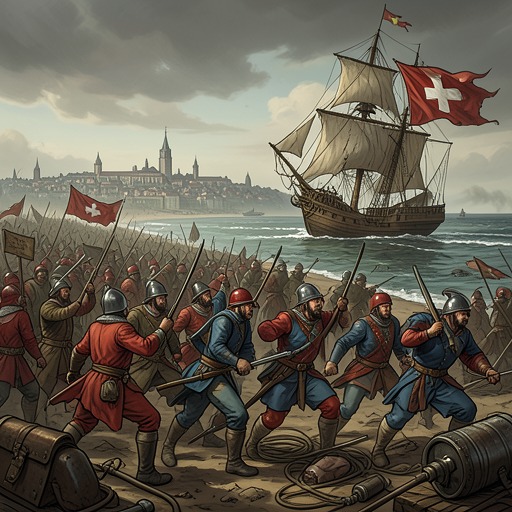
The Siege of La Rochelle magnifies the same dependence. The siege is designed to destroy the last major stronghold of French Calvinism, close the final French port open to England, and prevent a convergence of Protestant rebellion and foreign intervention. Englishmen, Spaniards, Italian malcontents, adventurers, and soldiers of fortune gather under the Protestant standard, while the royal camp relies on a blockade and the dyke to prevent ships from entering the city. Louis XIII is the king whose army undertakes this great enterprise, but Richelieu is the strategist and political force who carries its burden forward.
Even when La Rochelle is invested and success appears likely, the blockade threatens to last, embarrassing the royal army and inconveniencing the cardinal. Richelieu must also manage disputes involving M. de Bassompierre and the Duc d’Angouleme, while Monsieur, who began the siege, leaves the cardinal to finish it. The king’s government is therefore represented as a structure in which military success belongs formally to the crown but depends operationally on the minister’s energy, calculation, and surveillance.
Royal Retreat, Buckingham’s Death, and Narrative Significance
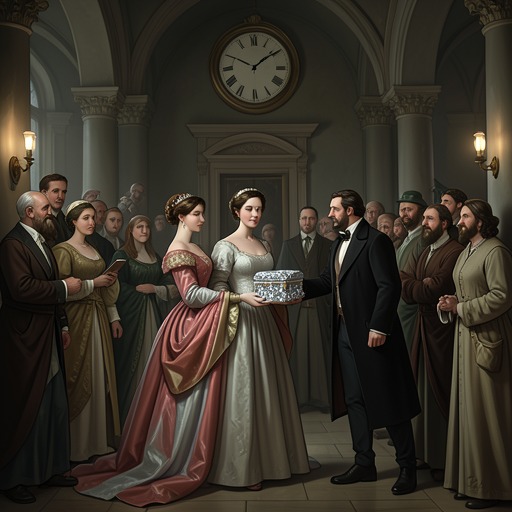
Louis XIII’s personal uncertainty becomes most visible after the death of the Duke of Buckingham. He leaves Paris to return to La Rochelle in accordance with his promise to Richelieu, while the news of Buckingham’s assassination spreads through the capital. Anne of Austria refuses at first to believe that the man she loved is dead, but Laporte arrives with the duke’s dying gift and confirms the fatal intelligence. Louis XIII does not conceal his joy; he displays it before the queen, and the narrative judges this display as a failure of generosity.
Yet the king’s triumph is unstable. He soon becomes dull and indisposed, sensing that his return to camp means re-entering a form of slavery. The image that follows defines his relationship with Richelieu: the cardinal is compared to a fascinating serpent, while Louis XIII is the bird that flies from branch to branch without being able to escape. The king can resent the minister, delay him, favor his enemies, or use the Musketeers as a counterweight, but he cannot free himself from the political system that Richelieu commands.
The final movement of the supplied narrative preserves this imbalance. At Surgeres, Richelieu and Louis XIII greet one another with repeated demonstrations of friendship and congratulate each other on the chance that has removed an enemy who set Europe against France. The king’s public partnership with the cardinal continues even after the private rivalry has been exposed. When Richelieu later approaches d’Artagnan, the young man is unarmed while the three Musketeers stand armed outside the minister’s lodging, showing that royal and ministerial authority still confront one another through dependent agents rather than through an open rupture between king and cardinal.
Louis XIII thus functions as both ruler and political emblem. He commands the crown but must borrow strength from Treville’s loyalty; he invokes law while permitting power to shape its application; he benefits from Richelieu’s victories while feeling trapped by the minister who achieves them. His fluctuating favor toward the Musketeers gives d’Artagnan access to advancement, while his dependence on competing military households turns personal courage into an instrument of state. Through Louis XIII, the novel makes the monarchy appear powerful in ceremony, vulnerable in practice, and permanently divided against itself.